Skip to content
Free shipping over $150 · $50 minimum order · Ships in 1–3 business days · COA for every lot
Log in
Peptides 98.3% purity Research Use Only · Not for Human or Veterinary Consumption

Glutathione

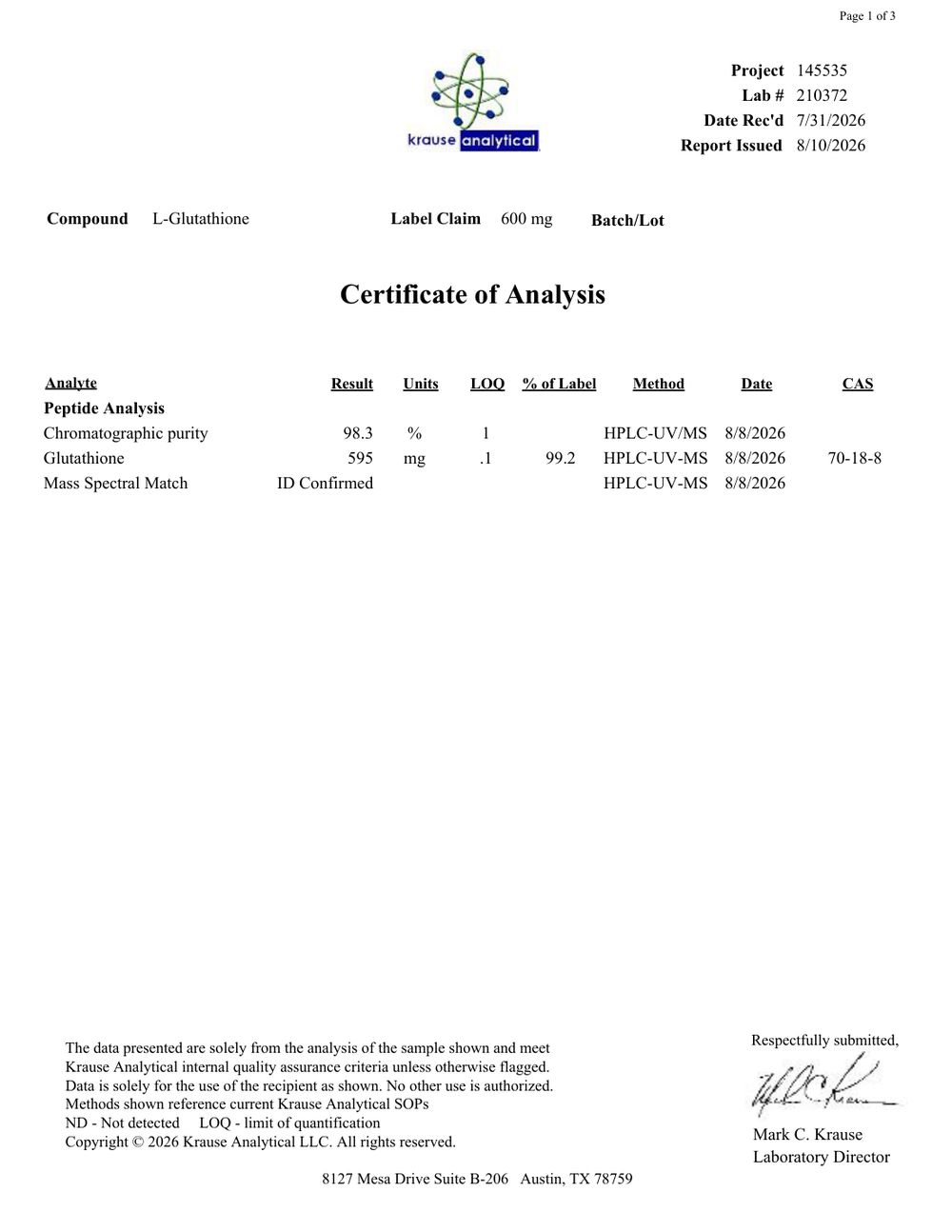
Glutathione supplied as a lyophilised 600 mg vial. Tested at 98.3% purity by an independent laboratory. Certificate published under lot KA-210372.

Purity
98.3% HPLC
Mol. weight
307.32 g/mol
Sequence
γ-Glu-Cys-Gly
Current lot
KA-210372 COA →
$57.99 $39.99 per vial, 600 mg

Quantity — volume pricing

30 ml +$14.99
In stock Lot KA-210372 View COA → $50 minimum order

At a glance

98+

Third-party purity

Every lot has a certificate from an independent laboratory, typically for HPLC purity and identity.

1–3

Business days to dispatch

Orders are usually prepared for shipment within 1–3 business days, then tracked end to end.

COA

Published before purchase

Read the latest certificate for the compound before you place the order, not after.

Certificate of analysis

The laboratory's report for the current lot

The certificate of analysis an independent laboratory issued for the lot listed here: typically purity by HPLC and identity, and endotoxins where the laboratory tested them.

Lot KA-210372
Purity 98.3% HPLC
Identity Confirmed by HPLC-UV-MS (mass spectral match) · 595 mg per vial (99.2 % of label)
Laboratory Krause Analytical
Tested August 8, 2026

Specification

Purity
98.3% by HPLC
Sequence
γ-Glu-Cys-Gly
CAS number
70-18-8
Molecular weight
307.32 g/mol
Molecular formula
C10H17N3O6S
Physical form
Lyophilised white powder
Net quantity
600 mg per vial
Current lot
KA-210372
Tested by
Krause Analytical
SKU
PFL-GLUTATHIONE-600-MG

Storage & reconstitution

Before opening

Lyophilised powder is stable at ambient temperature in transit. On arrival, keep sealed vials refrigerated at 2–8 °C, dry and dark. For storage beyond three months, keep at −20 °C.

Reconstitution

Follow your laboratory's own protocol.

After reconstitution

Refrigerate at 2–8 °C and protect from light. Use within 30 days. Discard if the solution becomes cloudy or discoloured.

For laboratory research use only. Not for human or veterinary consumption. Not a drug or dietary supplement.

Research record

Three characterised lines of work

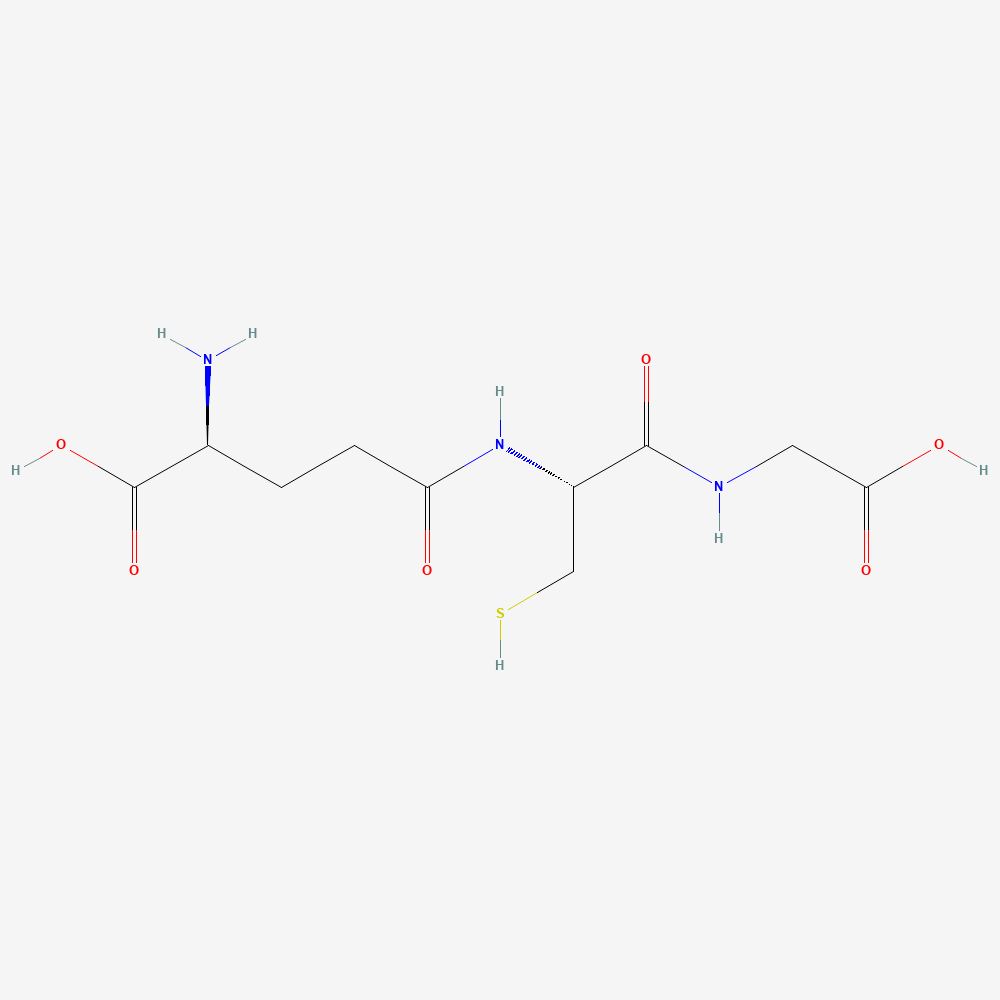
Glutathione is a naturally occurring tripeptide of glutamate, cysteine and glycine; the glutamate is joined through its side-chain (γ) carboxyl group. It has been studied for its role in cellular processes such as antioxidant activity, detoxification and the maintenance of cellular health. Research has focused on its involvement in redox balance, in protecting cells from oxidative stress and in various metabolic pathways.

01

Biosynthesis and its rate limits

The tripeptide is assembled in the cytosol from glutamate, cysteine and glycine by two enzymes in sequence: glutamate cysteine ligase, made up of a catalytic and a modifier subunit, and then glutathione synthetase. Synthesis is described as regulated primarily by the activity of the first enzyme, by the availability of cysteine, and by feedback inhibition from the product itself, with transcriptional control reported through Nrf2 acting at the antioxidant response element, along with AP-1 and NF-κB.

02

Redox couple and enzyme partners

Glutathione and its disulfide are described as the major redox couple in animal cells. Reviews are specific that the antioxidant function is substantially accomplished through glutathione-dependent enzymes rather than by direct scavenging alone: glutathione peroxidase-catalysed reduction of hydrogen peroxide, organic and lipid hydroperoxides and peroxynitrite, with peroxiredoxins contributing. Glutathione peroxidase-1 is a selenoenzyme, and glutathione is what supplies its reducing equivalents.

03

Mitochondrial pool

Synthesis takes place in the cytoplasm, from where the tripeptide is delivered to mitochondria and handles hydrogen peroxide inside them. Work on this pool describes a long-term imbalance between mitochondrial reactive oxygen species and the mitochondrial glutathione available to meet them as leading to cell dysfunction and to several distinct forms of cell death, including apoptosis, necroptosis and ferroptosis.

Published research areas

Research area Assay
Biosynthesis Glutamate cysteine ligase and glutathione synthetase activity assays
Redox status Ratio of glutathione to glutathione disulfide in cells and tissue
Enzyme partners Glutathione peroxidase and peroxiredoxin activity
Mitochondrial pool Hydrogen peroxide handling within isolated mitochondria
Precursor supply Cysteine, cystine, methionine and N-acetylcysteine as substrates

Two findings sit against the way this compound is commonly marketed. A 2016 review of glutathione as a skin-lightening agent found a dichotomy between the claims made for it and the evidence behind them, and stated that despite its popularity there is no evidence proving its efficacy for that purpose. Separately, work on cancer metabolism describes elevated glutathione as favouring tumour progression, correlating with increased metastasis and conferring resistance to treatment, which makes it a target for depletion rather than supplementation in that setting. The compound holds no FDA approval.

Regulatory status as of October 2026.

Structure

Glutathione 2D structure

2D structure · PubChem CID 124886

References

  1. 1 Forman HJ, Zhang H, Rinna A (2009) Glutathione: overview of its protective roles, measurement, and biosynthesis. Mol Aspects Med. 10.1016/j.mam.2008.08.006
  2. 2 Lu SC (2013) Glutathione synthesis. Biochim Biophys Acta. 10.1016/j.bbagen.2012.09.008
  3. 3 Wu G et al. (2004) Glutathione metabolism and its implications for health. J Nutr. 10.1093/jn/134.3.489
  4. 4 Lapenna D (2023) Glutathione and glutathione-dependent enzymes: from biochemistry to gerontology. Ageing Res Rev. 10.1016/j.arr.2023.102066
  5. 5 Handy DE, Loscalzo J (2022) The role of glutathione peroxidase-1 in health and disease. Free Radic Biol Med. 10.1016/j.freeradbiomed.2022.06.004
  6. 6 Chen TH et al. (2024) Mitochondrial glutathione in cellular redox homeostasis and disease manifestation. Int J Mol Sci. 10.3390/ijms25021314
  7. 7 Sonthalia S, Daulatabad D, Sarkar R (2016) Glutathione as a skin whitening agent: facts, myths, evidence and controversies. Indian J Dermatol Venereol Leprol. 10.4103/0378-6323.179088
  8. 8 Bansal A, Simon MC (2018) Glutathione metabolism in cancer progression and treatment resistance. J Cell Biol. 10.1083/jcb.201804161

Common questions

Ordering, handling and compliance. Anything not covered here, write to support@pureforgelabs.com.

What does research use only actually mean?

Every compound we sell is supplied for laboratory research and development only. It is not a drug, not a supplement, and not intended to diagnose, treat, cure or prevent any condition in humans or animals. Buying from this site means you are acquiring it for in vitro or other controlled research work.

Who is allowed to order?

Purchasers must be 21 or older and are responsible for compliance with the law where they take delivery. We ship to research institutions, laboratories and qualified individual researchers in the United States only. We do not ship to jurisdictions where these compounds are restricted.

How do I read the certificate of analysis?

Check three things in order. First, the lot code on the certificate matches the lot listed on the product page and in your order. Second, where the report gives an HPLC purity, its chromatogram shows a single dominant peak at the stated figure; a blend's report shows a peak for each compound. Third, where the lab ran mass spectrometry, the measured mass matches the expected molecular weight of the compound. Anything that does not line up, send us the lot code.

How should it be stored?

Unopened vials keep at ambient temperature short term, as in transit; on arrival, refrigerate them at 2–8 °C, and keep them at −20 °C beyond three months. Reconstitute following your laboratory's own protocol; once in solution, refrigerate at 2–8 °C, protect from light and use within 30 days.

When does it ship and how?

Orders are normally prepared for shipment within 1–3 business days and ship to street addresses in the United States only — not to P.O. boxes or APO/FPO/DPO military addresses. Shipping is free on orders over $150 and a flat $14.95 below that.

What payment methods do you take?

We take credit and debit cards, paid securely at checkout. Bank transfers and purchase orders are not available at the moment.

What if a vial arrives damaged?

Keep the vial and all the packaging, photograph the damage and email support@pureforgelabs.com within 48 hours of delivery with your order number. Once the claim is verified, we replace the vial or refund what you paid for it. Please do not send anything back unless we ask you to — apart from damaged or incorrect items, all sales are final.

Do you handle bulk and wholesale orders?

Yes, by quote. The volume tiers on the product pages go up to five vials; for larger research quantities email support@pureforgelabs.com with the compounds and amounts, and we will quote per gram.

FOR RESEARCH USE ONLY. NOT FOR HUMAN OR VETERINARY CONSUMPTION. This product is intended solely for legitimate laboratory, analytical, and scientific research. It is not intended to diagnose, treat, cure, mitigate, or prevent any disease and is not intended for human or veterinary administration or consumption. All products are intended for research and identification purposes only. These products are not intended for human dosing, injection, or ingestion.

$39.99
Glutathione · 600 mg · 1 vial

New compounds, restocks, lot releases.

One short email when something changes. No drip campaigns.